Question 1
A wireless engineer is hired to design a network for a technology company. The company campus has
four buildings and a warehouse with access points that provide full wireless coverage as well as a
pair of WLCs located in the core of the network. Which type of wireless architecture is being used?
- A. unified deployment
- B. autonomous deployment
- C. centralized deployment
- D. distributed deployment
Answer:
C
Explanation:
The wireless architecture described is a centralized deployment. This is characterized by access
points distributed across multiple buildings and managed centrally by Wireless LAN Controllers
(WLCs). Centralized deployments are common in larger environments like a technology company
campus because they allow for centralized management, scalability, and advanced features such as
load balancing and fault tolerance.
Reference:
CCNP Enterprise Wireless Design ENWLSD 300-425 and Implementation ENWLSI 300-430 Official
Cert Guide Premium Edition and Practice Tests
Comments
Question 2
Refer to the exhibit.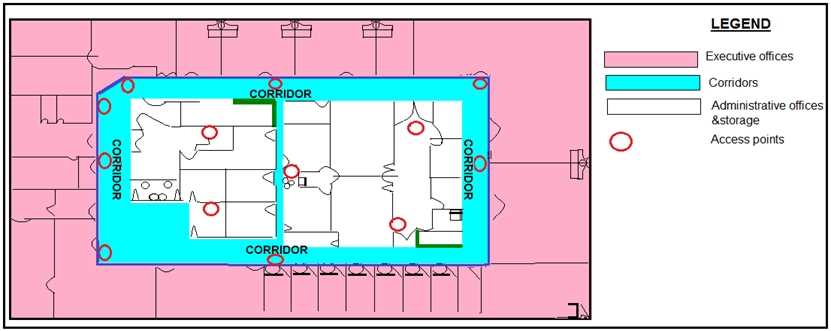
What is the main reason why the Wi-Fi design engineer took a different approach than installing the
APs in the offices, even though that installation provides better coverage?
- A. aesthetics
- B. transmit power considerations
- C. antenna gain
- D. power supply considerations
Answer:
B
Explanation:
The decision to avoid installing APs directly in offices is likely due to transmit power considerations.
Placing APs within offices could lead to excessive coverage for small areas, causing interference with
other APs and reducing overall network performance. By placing them in common areas like
corridors, engineers can ensure more uniform coverage across larger spaces while managing
transmit power more effectively for optimal performance.
Reference:
CCNP Enterprise Wireless Design ENWLSD 300-425 Official Cert Guide
https://www.cisco.com/en/US/docs/solutions/Enterprise/Mobility/emob30dg/RFDesign.html#wp10
00551
Comments
Question 3
Where must the APs be mounted when used in a high-density wireless network to provide 6 dB to 20
dB of attenuation to a cell?
- A. in the aisle
- B. under the seat
- C. above the stage
- D. under the stage
Answer:
B
Explanation:
In high-density environments, such as stadiums or auditoriums, APs are often mounted under the
seats to provide a controlled cell size with attenuation. This placement helps to manage the RF
environment by providing attenuation of 6 dB to 20 dB, which can reduce co-channel interference
and improve the user experience by ensuring a strong signal and minimizing noise from other cells.
Comments
Question 4
A company wants to replace its existing PBX system with a new VoIP System that will include wireless
IP phones. The CIO has concerns about whether the company’s existing wireless network can
support the new system. Which tool in Cisco Prime can help ensure that the current network will
support the new phone system?
- A. Location Readiness
- B. Site Calibration
- C. Map Editor
- D. Voice Readiness
Answer:
D
Explanation:
The Voice Readiness tool within Cisco Prime Infrastructure is designed to assess the wireless
network’s ability to support voice services, including VoIP. It evaluates various factors such as signal
strength, noise levels, and coverage to ensure that the wireless network can handle the quality of
service requirements needed for voice communications.
Comments
Question 5
A rapidly expanding company has tasked their network engineer with wirelessly connecting a new
cubicle area with Cisco workgroup bridges until the wired network is complete. Each of 42 new users
has a computer and VoIP phone. How many APs for workgroup bridging must be ordered to keep
cost at a minimum while connecting all devices?
- A. 4
- B. 5
- C. 6
- D. 7
Answer:
C
Explanation:
Cisco workgroup bridges typically support up to 8 wired clients. With 42 users, each having a
computer and a VoIP phone, that’s a total of 84 devices. To connect all devices while keeping costs at
a minimum, the company would need 6 APs (as 7 x 12 = 84), with each AP supporting 14 devices (7
computers and 7 VoIP phones).
So, each AP will have 25 clients. Minimum 4 APs are sufficient.
Comments
Question 6
Which two considerations must a network engineer have when planning for voice over wireless
roaming? (Choose two.)
- A. Full reauthentication introduces gaps in a voice conversation.
- B. Roaming time increases when using 802.1x + Cisco Centralized Key Management.
- C. Roaming occurs when the phone has seen at least four APs.
- D. Roaming occurs when the phone has reached -80 dBs or below.
- E. Roaming with only 802.1x authentication requires full reauthentication.
Answer:
A,E
Explanation:
Voice over wireless roaming is sensitive to delays and interruptions. Full reauthentication, as
mentioned in option A, can cause noticeable gaps in a voice conversation because it requires time to
re-establish security credentials. This process can interrupt the seamless experience expected in
voice communications. Option E is also correct because roaming with only 802.1x authentication
indeed requires full reauthentication, which can introduce significant delays affecting voice
quality. Reference: For more detailed information, refer to the CCNP Enterprise Wireless Design
ENWLSD 300-425 and Implementation ENWLSI 300-430 Official Cert Guide.
https://www.cisco.com/c/en/us/td/docs/solutions/Enterprise/Mobility/vowlan/41dg/vowlan41dg-book/vowlan_ch5.html
Comments
Question 7
An engineer is designing a wireless network that will support many different types of wireless clients.
When conducting the survey, which client must be used to ensure a consistent experience for all of
the wireless clients?
- A. the client that has the highest RF properties
- B. the client that is used most by the company
- C. the client that is used least by the company
- D. the client with the worst RF characteristics
Answer:
D
Explanation:
When designing a wireless network for diverse clients, it’s crucial to ensure that the network will be
reliable for all users. Therefore, surveys should be conducted with the client that has the worst RF
characteristics, as indicated in option D. This approach ensures that the network is designed to
support even the weakest client, thereby providing a consistent experience for all users.
https://documentation.meraki.com/MR/WiFi_Basics_and_Best_Practices/Conducting_Site_Surveys_
with_MR_Access_Points
Comments
Question 8
Refer to the exhibit.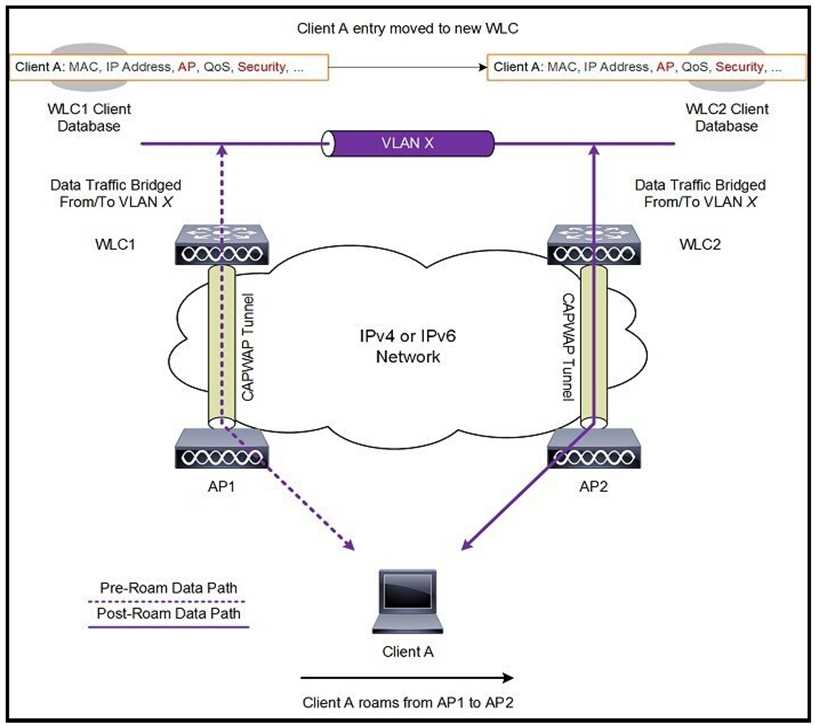
A client roams between two APs that are registered to two different controllers, where
each controller has an interface in the client subnet. Both controllers are running AireOS. Which
scenario explains the client roaming behavior?
- A. Controllers exchange mobility control messages (over UDP port 16666) and the client database entry is moved from the original controller to the new controller.
- B. Controllers do not exchange mobility control messages (over UDP port 16666) andthe client database, entry is not moved from the original controller to the newcontroller.
- C. Controllers exchange mobility control messages (over UDP port 16666) and a new client session is started with the new controller.
- D. Controllers exchange mobility control messages (over UDP port 16666) and the client database entry is tunneled from the original controller to the new controller.
Answer:
A
Explanation:
When a client roams between two access points (APs) that are registered to different controllers
with interfaces in the same client subnet, the controllers will exchange mobility control messages
over UDP port 16666. This is in accordance with the Designing Cisco Enterprise Wireless Networks
(ENWLSD) guidelines. The purpose of these messages is to ensure seamless roaming, where the
client’s session and authentication state are transferred from one controller to another without
requiring re-authentication or re-association by the client. The mobility control messages facilitate
the coordinated transfer of the client database entry from the original controller to the new one,
maintaining a consistent experience for the user.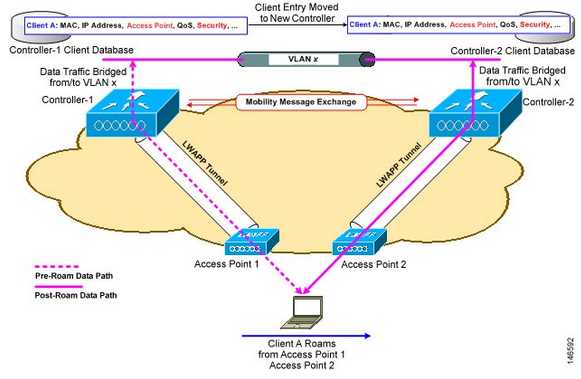

Comments
Question 9
An engineer has performed a predictive site survey for high-speed data and voice in an indoor office.
What is the recommended data rate with -67 dBm signal level for optimal VoWLAN design?
- A. 6 Mbps on 802.11 bgn
- B. 24 Mbps on 802.11 bgn
- C. 12 Mbps on 802.11 an
- D. 24 Mbps on 802.11 an
Answer:
D
Explanation:
For optimal Voice over WLAN (VoWLAN) design, a higher data rate is preferred to ensure quality of
service and reliability. -67 dBm is a commonly recommended signal level for VoWLAN, and 802.11an,
which operates in the 5 GHz band, is capable of supporting higher data rates compared to
802.11bgn, which operates in the 2.4 GHz band. The 5 GHz band is less crowded and prone to
interference, making it suitable for high-speed data and voice applications.
Comments
Question 10
An engineer has configured guest anchoring for a newly created SSD however, the mobility tunnels
are not up, and EPING is failing from the foreign WLC to the anchor WLC. Which traffic flow must be
allowed at the firewall to enable the communication?
- A. UDP port 16666
- B. IP protocol 97
- C. UDP port 97
- D. TCP port 97
Answer:
A
Explanation:
Mobility tunnels between Cisco Wireless LAN Controllers (WLCs) use UDP port 16666 for control
messages and UDP port 16667 for data traffic. If EPING is failing, it indicates that the necessary ports
are not open. Allowing UDP port 16666 through the firewall would enable the control messages
required for establishing the mobility tunnels.
Comments
Page 1 out of 25
Viewing questions 1-10 out of 256
page 2