Question 1
What is one reason to deploy an Aruba CX switch when compared to an ArubaOS switch?
- A. to obtain API-enabled programmability for greater automation
- B. to support Aruba Dynamic Segmentation
- C. to obtain higher wattage power modules for enhanced PoE+ support
- D. to support Zero Touch provisioning (ZTP)
Answer:
C
Comments
Question 2
Refer to the exhibit.
A customer has an existing network with ArubaOS switches, Aruba 7205 controller, and 802.11ac
APs. The customer needs a wired upgrade for their campus network and wireless upgrade with
802,11ax APs and would like to get all the functions of AP.
The customer has one building with 3 floors with the following wired devices,
* 200 VOIP phones
* 8 printers
* security cameras
The architect plans to propose 75 AP-535s.
The security cameras are a high definition pan-tilt-zoom with heaters for harsh environments that
require more than 45 W to function,
Which exhibit shows an access switch mat meets the customer needs?
A)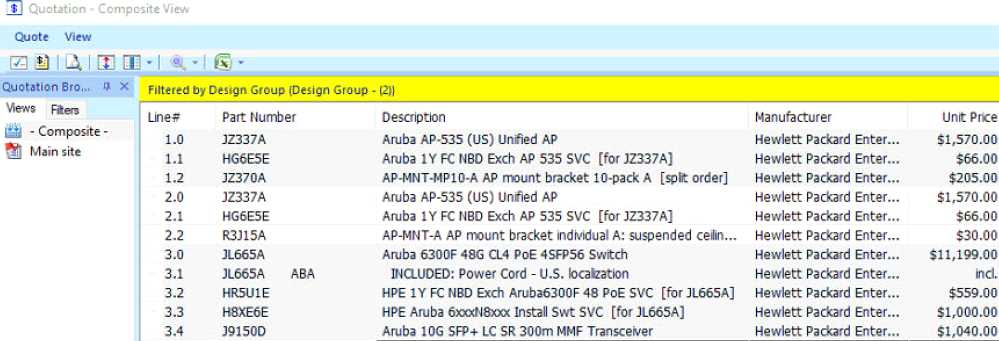
B)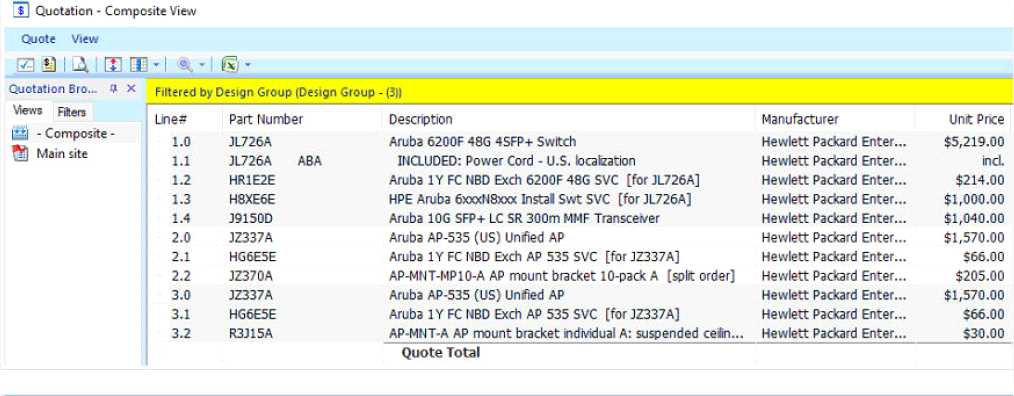
C)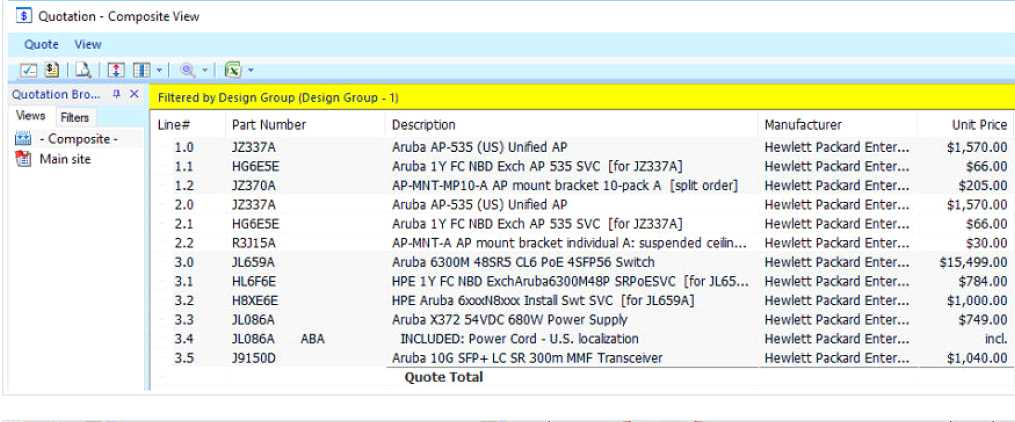
D)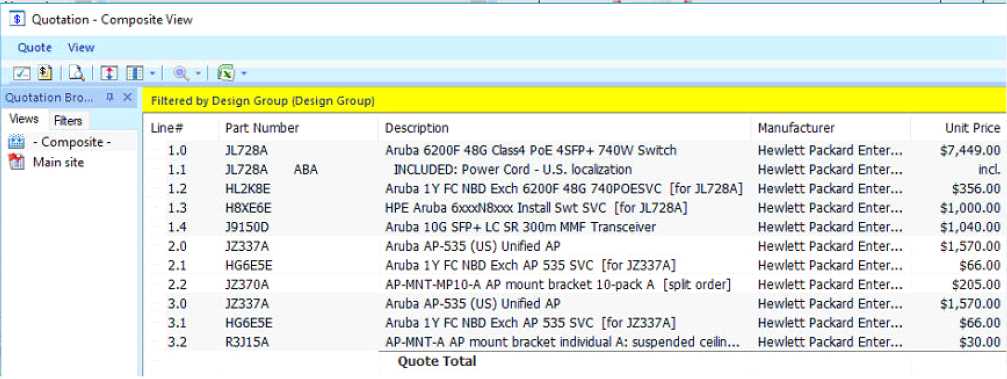
- A. Option A
- B. Option B
- C. Option C
- D. Option D
Answer:
D
Comments
Question 3
DRAG DROP
Match each hospital room with a potential issue for the AP design (Each match will be used once. )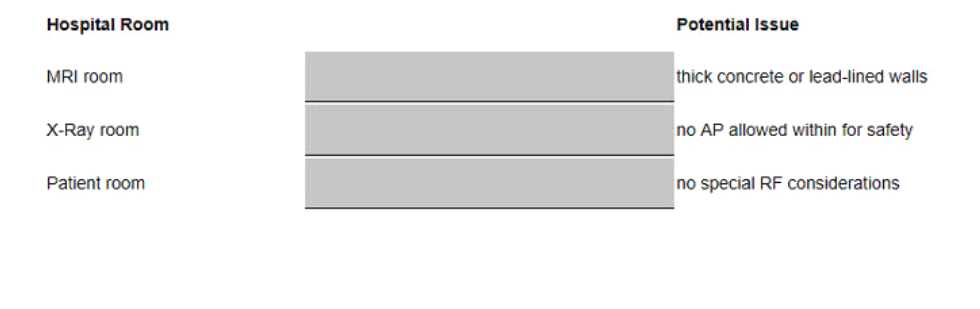
Answer:
None
Comments
Question 4
in which scenario do Aruba CX 6400 Series switches, but not Aruba 6300M Series switches, meet the
needs Tor a wired upgrade?
- A. The customer requires switches in the same closet to operate together as a single switch for Link Aggregation but to be managed as separate devices.
- B. The customer requires enhanced redundancy at the access layer and wants to ensure that each switch can continue to operate even if a power supply fails
- C. The customer requires each access layer switch to support at least 25Gbps on its fiber uplinks at all times; including if up to one uplink tails.
- D. The customer has recently deployed Aruba AP-535 APs and is concerned about a future-proof wired edge that will continue to support expanding bandwidth requirements.
Answer:
A
Comments
Question 5
Compare the scenarios below. For which scenario do AP-575S meet the needs?
- A. The customer needs APs for an Indoor nigh density environment In which tne customer prefers dual 5GHz operation.
- B. The customer needs APs for an indoor stadium that requires overhead coverage and directional antennas.
- C. The customer needs to mount APs in an outdoor area, but that area only has fiber cable available,
- D. The customer needs APS mounted to a concrete building exterior to provide coverage in a 90 foot (27m) radius from the building.
Answer:
C
Comments
Question 6
Refer to the exhibit.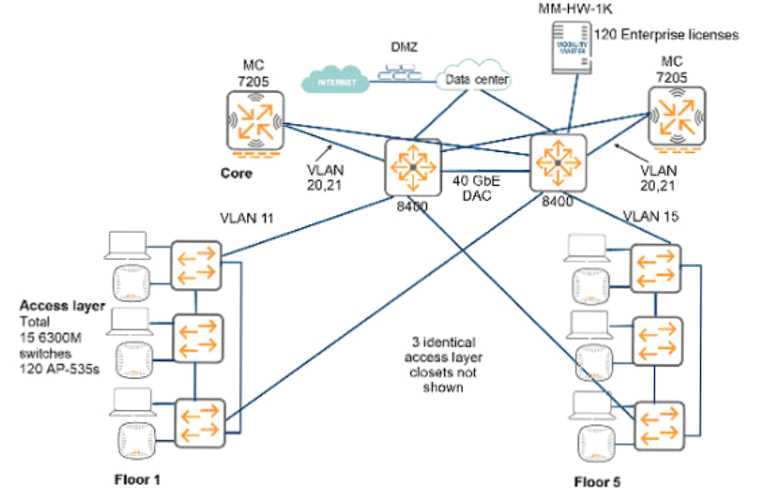
A customer has these availability requirements;
loss of one controller with stateful failover and without impact on wireless client connectivity
loss of one core switch without loss of connectivity for any endpoints or APs in the building
loss of any one switch-lo-switch or MC-to-switch link without loss of connectivity for any endpoints
or APS in the
building and with minimal impact on infrastructure functionality
loss of any one access switch with minimal impact to wireless client connectivity
The exhibit shows the current plan for the topology.
Which change should the architect make to the plan to provide better support for the customers
availability requirements?
- A. Add VLANs 11 and 15 to the MC connections to ensure both MCS can manage any of the APS.
- B. Add 120 additional AP licenses, so that each MC can support ail the APs, even if the other MC fails.
- C. Use two 40GBE DACs between the core V3X switches for their switch links.
- D. Change the 40GbE DAC on the 8400 switch to a stacking cable with stacking module.
Answer:
B
Comments
Question 7
A customer needs an AP for an indoor lecture nail mat is about 82 feet (25 m) by 32 feet (25 m) and
has 300 seats. The ceiling height is 15 feet The expected take rate is 100 percent.
The network needs to support the student laptops, which all support S02.Hac and some support
802.11ax standard.
The customer would like to obtain as many usable cells as possible with as few APs as possible.
Which of these APs meets the requirements?
- A. AP-335
- B. AP-S15
- C. AP-345
- D. AP-535
Answer:
D
Comments
Question 8
What is one customer requirement that can drive the need for a relatively dense AP deployment. In
which ire coverage areas of at least three AP radios overlap?
- A. AP operation as hybrid AMs for IDS/WIPS
- B. the deployment of dual SGHz radio APs
- C. support for beacon management
- D. location tracking of wireless loT devices
Answer:
C
Comments
Question 9
A customer has an Aruba wireless netwofK with:
* Two 7205 Mobility Controllers (MCs) in a cluster - Each MC must be able to support the complete
network in the case of an MC failure
* 250 APs. which support a total of 7.500 devices
* A virtual CxQCQ ClearPass appliance with 1QK Access licenses
* An MM-HW-1K appliance
The customer is interested in an upgrade to Aruba CX Switches, primarily to benefit from the per-
user tunneled node
feature. The customer requires support for 2500 ports, and 95 percent of wined endpoints will use
tunneled node.
Which change to the existing solution should the architect explain?
- A. A separate ClearPass virtual appliance will be required to integrate with the AQS-Switches
- B. The clustering feature will need to be disabled on the controllers, so that they can support tunneled node.
- C. A new controller will be required to support sufficient clients, including the wired ones.
- D. The Mobility Master will need more MM licenses to support the wired endpoints that use tunneled node.
Answer:
B
Comments
Question 10
A company already has an Aruba wireless network The network currently consists of:
* oneMM-HW-1k
* two 7210 MCs in the network core
* two 721GMCsintheDMZ
* 200 AP-515S in Building 1 and Building 5
100 AP-515S each In Building 2r Building 3, and Building 4
The customer now wants to assess if it needs local Mobility controllers (MC) for any buildings:
- Building 1 is the main office building for the campus. It supports the highest number of APs. It
connects to the
network core without an aggregation layer.
* Building 2 is further away from the Building i. and no roaming is provided between it and the other
buildings its
access layer connects to the network cone with a pair of Aruba CX 6300M aggregation switches.
* Building 3 is further away from the other buildings, it connects to the network core without an
aggregation layer.
The Guest SSID traffic should be tunnelled to the DMZ controllers
Building 4 has its own local datacenter and Internet connection. The company would like it to be
able to operate
completely autonomously if its aggregation layer loses connectivity with the core.
* Building 5 is further away from the other buildings, it connects to the network core without an
aggregation layer.
This building has been assigned to a partner that would like to manage a dedicated SS1D using the
shared AP infrastructure.
In which two buildings should the network architect plan local mobility controllers (MCs)? (Select
two)
- A. Building 1
- B. Building 4
- C. Building 5
- D. Building 3
- E. Building 2
Answer:
AD
Comments
Page 1 out of 5
Viewing questions 1-10 out of 60
page 2