Question 1
A company needs to Increase its Infrastructure capacity quickly to accommodate their rapid business
growth. Which cloud use case describes their requirement?
- A. Maintain and Modernize
- B. Consolidate and Migrate
- C. Disaster Recovery
- D. Maintain and Expand
Answer:
D
Explanation:
The cloud use case that describes the requirement of increasing the infrastructure capacity quickly
to accommodate the rapid business growth is Maintain and Expand1
.
This use case is suitable for
organizations that want to leverage the cloud to scale their existing data center capacity on demand,
without changing their existing applications or processes1
.
VMware Cloud on AWS enables this use
case by providing a consistent and compatible cloud platform that can be integrated with the on-
premises VMware environment1
.
VMware Cloud on AWS allows customers to add or remove hosts
from their SDDC cluster in minutes, using the Elastic DRS feature2
.
Customers can also use the
VMware HCX service to migrate workloads between on-premises and cloud SDDCs seamlessly and
securely3. Reference: 1: Use Cases for VMware Cloud on AWS, 2: Manage Elasticity in SDDC Clusters -
VMware Docs, 3
: Migrate Workloads Using VMware HCX - VMware Docs
Comments
Question 2
Which out-of-the-box role is required in order to create a content library In VMware Cloud on AWS?
- A. CloudGlobalAdmln
- B. CloudAdmin
- C. Active Directory ESXi Admin
- D. Ad mlnistrator@vSphere. local
Answer:
B
Explanation:
The CloudAdmin role has the privileges necessary to create and manage SDDC workloads and related
objects such as storage policies, content libraries, vSphere tags, and resource pools
The CloudAdmin role has the following privileges in SDDC Version 1.18.
ContentLibrary.AddCertToTrustStore
ContentLibrary.AddLibraryItem
ContentLibrary.CheckInTemplate
ContentLibrary.CheckOutTemplate
ContentLibrary.CreateLocalLibrary
ContentLibrary.CreateSubscribedLibrary
ContentLibrary.DeleteCertFromTrustStore
ContentLibrary.DeleteLibraryItem
ContentLibrary.DeleteLocalLibrary
ContentLibrary.DeleteSubscribedLibrary
ContentLibrary.DownloadSession
ContentLibrary.EvictLibraryItem
ContentLibrary.EvictSubscribedLibrary
ContentLibrary.GetConfiguration
ContentLibrary.ImportStorage
ContentLibrary.ProbeSubscription
ContentLibrary.ReadStorage
ContentLibrary.SyncLibrary
ContentLibrary.SyncLibraryItem
ContentLibrary.TypeIntrospection
ContentLibrary.UpdateConfiguration
ContentLibrary.UpdateLibrary
ContentLibrary.UpdateLibraryItem
ContentLibrary.UpdateLocalLibrary
ContentLibrary.UpdateSession
ContentLibrary.UpdateSubscribedLibrary
https://docs.vmware.com/en/VMware-Cloud-on-AWS/services/com.vmware.vsphere.vmc-aws-manage-data-center-vms.doc/GUID-DFB3C048-5728-4DE9-9380-7240748875C3.html
Comments
Question 3
What is one way in which VMware Multi-Cloud addresses challenges with the cloud computing
model?
- A. Provides savings on capital expenses and the use of a flexible payment structure where payment Is only done based on the resources used.
- B. Provides visibility and tools to manage resources, workloads and operations across clouds from a common operating environment.
- C. Eliminates worry associated with managing IT infrastructures and shifts focus to application development and other priorities using the most up-to-date technology.
- D. Increases agility that encompasses scalability, customizability, and access to the cloud service from anywhere and on any device.
Answer:
B
Explanation:
https://www.vmware.com/topics/glossary/content/multi-cloud.html
VMware Multi-Cloud provides visibility and tools to manage resources, workloads and operations
across clouds from a common operating environment. This eliminates the need to manage multiple
cloud environments in different clouds and provides a unified view of all cloud resources and
applications. This makes it easier to monitor and manage workloads across clouds, reducing
complexity and increasing agility. VMware Multi-Cloud also provides powerful automation and
orchestration capabilities to help streamline operations and improve efficiency. [1]
[1]
https://www.vmware.com/products/vmware-multi-cloud.html
Comments
Question 4
A customer is looking to leverage a VMware Public Cloud solution to provide them with additional
compute capacity as seasonal demand increases for their online business.
The current on-premises data center is configured as follows:
• VMware vSphere 7.0
• VMware vSphere Distributed Switch (vDS) 7.0
• Management and Server network - 172.18.0.0/16
• vMotion network - 192.168.120.0/24
• 250 application servers
Given the information in the scenario, which capability of VMware HCX will the customer not be able
to utilize?
- A. Cold migration
- B. Layer 2 extension
- C. Bulk migration
- D. WAN optimization
Answer:
B
Explanation:
According to the VMware official guide, VMware Tanzu Service Mesh is a cloud-native service mesh
platform that simplifies the secure communication between microservices running in Kubernetes
clusters . It provides secure and consistent network communication between services and enables
policy-driven authorization and observability. With its distributed tracing capabilities, Tanzu Service
Mesh can help administrators easily monitor and troubleshoot their applications. It also provides a
unified platform to manage the lifecycle of Tanzu Kubernetes clusters, including provisioning,
upgrades, patching, and more.
Management “and Server” network - 172.18.0.0/16
“and Server” being the 250 application servers.
https://docs.vmware.com/en/VMware-HCX/4.6/hcx-user-guide/GUID-DBDB4D1B-60B6-4D16-936B-4AC632606909.html
Detected and Restricted Source Network Types
The HCX Network Extension service detects and prevents several non-supported Network Extension
scenarios (items are dimmed in the Network Extension UI):
• vSphere infrastructure networks (ESXi VMkernel networks).
Comments
Question 5
Refer to the exhibit.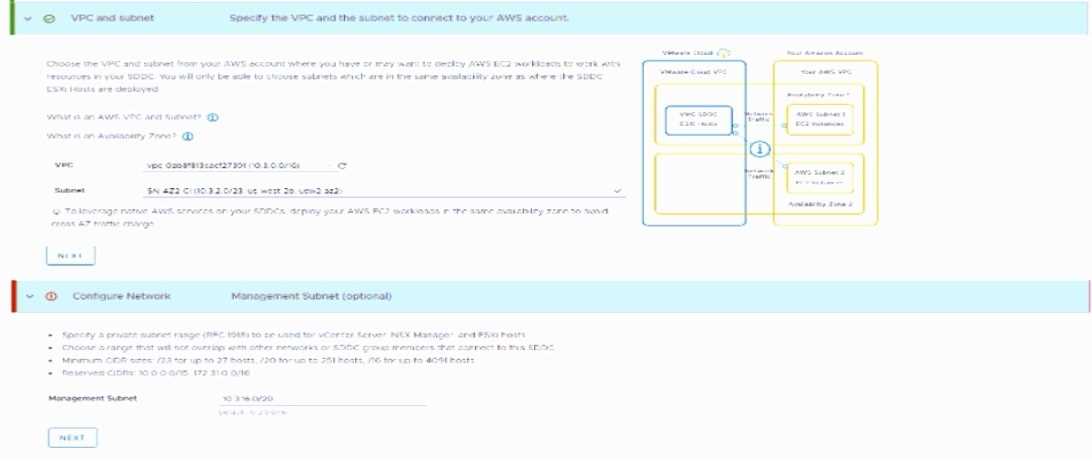
A cloud administrator is deploying a new VMware Cloud on AWS virtual private cloud (VPC). After
clicking on deploy, the screen refreshes and displays the information that is provided in the exhibit.
What is the issue with the management CIDR that is causing the deployment to fall?
- A. It overlaps with the AWS subnet.
- B. It overlaps with the AWS VPC CIDR.
- C. It is part of the reserved CIDRs.
- D. It is an invalid size.
Answer:
A
Explanation:
https://docs.aws.amazon.com/whitepapers/latest/sddc-deployment-and-best-practices/deploying-vmware-cloud-on-aws-sddc.html
This must be a RFC1918 private address space (10.0.0.0/8,
172.16.0.0/12, or 192.168.0.0/16) with CIDR block sizes of /16, /20, or /23. The management CIDR
block cannot be changed after the SDDC is deployed. Choose a range of IP addresses that does not
overlap with the AWS subnet you are connecting to. If you plan to connect the SDDC to an on-
premises DC or another environment, the IP subnet must be unique within your enterprise network
infrastructure. Choose a CIDR that will give you future scalability.
Comments
Question 6
Which two steps should an administrator take to allow HTTPS access to a specific virtual machine
(VM) through the public Internet for VMware Cloud on AWS? (Choose two.)
- A. Create a custom service called HTTPS using port 443.
- B. Configure AWS Direct Connect.
- C. Configure a SNAT rule translating an internal IP address to a public IP address.
- D. Request a public IP address in the VMware Cloud console.
- E. Configure a DNAT rule translating a public IP address to an internal IP address.
Answer:
DE
Explanation:
https://docs.vmware.com/en/VMware-Cloud-on-AWS/services/com.vmware.vmc-aws-networking-security/GUID-0E34C56D-C49C-49B6-A9CF-FBFAF14A126C.html
To allow HTTPS access to a specific VM through the public Internet for VMware Cloud on AWS, the
administrator should take the following two steps:
Request a public IP address in the VMware Cloud console.
This is required because the VM needs a
public IP address to be reachable from the Internet1
.
The administrator can request a public IP
address from the Networking & Security tab in the VMware Cloud console1
.
The public IP address is
allocated from the AWS pool and is associated with the SDDC1
.
Configure a DNAT rule translating a public IP address to an internal IP address.
This is required
because the VM has an internal IP address assigned by the SDDC DHCP server, and the DNAT rule
maps the public IP address to the internal IP address of the VM2
.
The administrator can configure a
DNAT rule from the Networking & Security tab in the VMware Cloud console2
.
The DNAT rule must
specify the public IP address as the source, the internal IP address as the destination, and the HTTPS
service (TCP 443) as the applied to2. Reference: 1: Request a Public IP Address - VMware Docs, 2
:
Configure NAT Rules - VMware Docs
Comments
Question 7
An administrator wants to have a global view of all managed Tanzu Kubernetes clusters and manage
the policies across them. Which solution would the administrator use?
- A. VMware Tanzu Mission Control
- B. VMware Tanzu Observability by Wavefront
- C. VMware Tanzu Service Mesh
- D. VMware Tanzu Kubernetes Grid
Answer:
A
Explanation:
VMware Tanzu Mission Control provides a central platform to manage and view all Tanzu Kubernetes
clusters and workloads running in the environment. It allows administrators to set policies across
multiple clusters, set up cluster identities, monitor cluster health and performance, and much more.
Tanzu Mission Control also provides access to a variety of cloud-native tools, such as Kubernetes
Dashboard, Helm, and Kubeapps.
https://vcdx.vmware.com/content/dam/digitalmarketing/vmware/ru/pdf/techpaper/vmware-
horizon-7-application-publishing.pdf
Publishing Applications with VMware Horizon 7
https://vcdx.vmware.com/content/dam/digitalmarketing/vmware/ru/pdf/techpaper/vmware-
horizon-7-application-publishing.pdf
https://www.vmware.com/pdf/techsupportguide.pdf
VMware Technical Support Guide
https://www.vmware.com/pdf/techsupportguide.pdf
https://techzone.vmware.com/resource/quick-start-tutorial-vmware-dynamic-environment-manager
Quick-Start Tutorial for VMware Dynamic Environment Manager ...
https://techzone.vmware.com/resource/quick-start-tutorial-vmware-dynamic-environment-manager
"VMware Tanzu® Mission ControlTM is a centralized management platform for consistently
operating, managing, and securing Kubernetes infrastructure and modern applications across teams
and clouds. It provides a global view of all of the Kubernetes clusters. You can use the resource
hierarchy to manage and enforce consistent policies across Kubernetes clusters. "
Comments
Question 8
A cloud administrator is asked to evaluate a number of disaster recovery solutions for the business.
The current on-premises environment Is built around the latest version of VMware vSphere 7.0.
The following requirements must be met:
• Follow an on-demand cloud consumption model
• Must be a managed offering
• Deliver a recovery point objective (RPO) of no more than 30 minutes
• Rapid power-on of recovered virtual machines/ assuming cloud capacity availability
• Must accommodate for single region failure
Which solution would meet these requirements?
- A. VMware Cloud Disaster Recovery
- B. VMware Cloud on AWS Stretched Cluster
- C. VMware vSphere Replication
- D. VMware Site Recovery Manager
Answer:
A
Explanation:
VMware Cloud Disaster Recovery is a managed disaster recovery-as-a-service offering that is built on
the latest version of VMware vSphere 7.0. It provides an on-demand cloud consumption model,
allowing administrators to rapidly power-on recovered virtual machines in the cloud, assuming cloud
capacity availability. Additionally, VMware Cloud Disaster Recovery delivers a recovery point
objective (RPO) of no more than 30 minutes, and can accommodate for single region failure.
https://vcdx.vmware.com/content/dam/digitalmarketing/vmware/ru/pdf/techpaper/vmware-
horizon-7-application-publishing.pdf
Publishing Applications with VMware Horizon 7
https://vcdx.vmware.com/content/dam/digitalmarketing/vmware/ru/pdf/techpaper/vmware-
horizon-7-application-publishing.pdf
https://www.vmware.com/pdf/techsupportguide.pdf
VMware Technical Support Guide
https://www.vmware.com/pdf/techsupportguide.pdf
https://techzone.vmware.com/resource/quick-start-tutorial-vmware-dynamic-environment-manager
Quick-Start Tutorial for VMware Dynamic Environment Manager ...
https://techzone.vmware.com/resource/quick-start-tutorial-vmware-dynamic-environment-manager
VMware Cloud Disaster Recovery ----------------------------------------------------- * Protect your workloads
running on VMware Cloud on AWS SDDC using high-frequency snapshots to achieve RPOs as low as
30 minutes. * Availability Zone Failure Handling
https://docs.vmware.com/en/VMware-Cloud-Disaster-Recovery/services/vmware-cloud-disaster-recovery/GUID-067EE6DF-80CC-44D2-94E6-D7183A239D9A.html
https://docs.vmware.com/en/VMware-Cloud-Disaster-Recovery/services/rn/vmware-cloud-
disaster-recovery-release-notes/index.html
Comments
Question 9
A cloud administrator is planning to migrate 1,000 VMs from their existing on-premises location into
VMware Cloud on AWS. The migration will need to be completed as quickly as possible. Upon
completion, the users will need the most reliable, lowest latency connection possible.
Which on-premises data center connectivity option will meet these requirements?
- A. Layer 2 VPN
- B. AWS Direct Connect
- C. VMware Transit Connect
- D. IPsec VPN
Answer:
B
Explanation:
The best option to meet the requirements of quickly migrating 1,000 VMs with the lowest latency
and most reliable connection possible is to use AWS Direct Connect. AWS Direct Connect provides a
dedicated network connection between an on-premises data center and the Amazon Web Services
(AWS) cloud, allowing for the transfer of data across the two locations. It is more reliable and has
lower latency than other options such as Layer 2 VPN, VMware Transit Connect, and IPsec VPN.
Additionally, AWS Direct Connect provides the highest performance and throughput of any of the on-
premises data center connectivity options.
https://communities.vmware.com/t5/VMware-Education-Services/Why-does-VMware-refuse-to-
educate-their-customers/td-p/2005973
Why does VMware refuse to educate their customers ... - VMware ...
https://communities.vmware.com/t5/VMware-Education-Services/Why-does-VMware-refuse-to-
educate-their-customers/td-p/2005973
https://www.vmware.com/pdf/techsupportguide.pdf
VMware Technical Support Guide
https://www.vmware.com/pdf/techsupportguide.pdf
https://vcdx.vmware.com/content/dam/digitalmarketing/vmware/ru/pdf/techpaper/vmware-
horizon-7-application-publishing.pdf
Publishing Applications with VMware Horizon 7
https://vcdx.vmware.com/content/dam/digitalmarketing/vmware/ru/pdf/techpaper/vmware-
horizon-7-application-publishing.pdf
Comments
Question 10
Which two networking planes are converged in a VMware NSX-T Data Center? (Choose two.)
- A. Control Plane
- B. I/O Plane
- C. Management Plane
- D. Consumption Plane
- E. Data Plane
Answer:
AC
Explanation:
According to
, VMware NSX-T Data Center implements three separate but integrated planes:
management, control, and data.
The management plane provides a single point of configuration and REST API entry-points for NSX-T
Data Center components.
The control plane is responsible for computing network state based on configuration from the
management plane and topology information from transport nodes.
The data plane consists of transport nodes that provide connectivity for workloads and enforce
network policies.
Overview of NSX-T Data Center:
https://docs.vmware.com/en/VMware-NSX-T-Data-Center/3.2/installation/GUID-10B1A61D-4DF2-481E-A93E-C694726393F9.html
Comments
Page 1 out of 12
Viewing questions 1-10 out of 126
page 2